

Platinum Price Forecast: Trends and Outlook
📈 Discover what’s driving platinum prices 🔍 and get a clear outlook on trends, market forces, and economic impacts shaping the South African market.
Edited By
Sophie Carter
The AUD/USD currency pair remains a popular focus for traders and investors, reflecting the economic pulse between Australia and the United States. Its fluctuations offer a clear window into how various factors interact, influencing market sentiment and capital flows. Understanding these trends requires a close look at the intertwined economic indicators, geopolitical events, and technical analysis shaping the pair.
Australia’s economy, heavily linked to commodity exports such as iron ore and coal, responds sharply to demand shifts, especially from China, its biggest trading partner. For instance, a slowdown in Chinese industrial output or trade disruptions can lead to a weaker Australian dollar. On the other hand, the US dollar often behaves as a global safe haven, strengthening during times of uncertainty, which puts downward pressure on the AUD/USD rate.

Traders need to monitor economic releases like Australia's employment figures and US non-farm payrolls closely, as these often trigger significant moves in the pair.
At the same time, central bank policies set by the Reserve Bank of Australia (RBA) and the US Federal Reserve heavily influence the exchange rate. Interest rate decisions, inflation expectations, and monetary policy outlooks lead markets to adjust their views on currency value. For example, if the Fed signals a more aggressive rate hike path while the RBA remains cautious, the AUD/USD typically trends lower.
Technical analysis plays a complementary role, helping traders spot key support and resistance levels where price may pause or reverse. Watching patterns such as double tops or moving average crossovers offers useful clues on short-term momentum shifts.
In this article, we will break down the current trends affecting AUD/USD and explore how economic data, geopolitics, and technical factors combine to guide its movements. This will equip you with practical insights to better anticipate shifts and manage your positions.
Key points covered:
Impact of commodity prices and trade dynamics
Central bank policy comparisons
Relevant economic indicators and how to interpret them
Technical levels to watch
With these tools, you can sharpen your understanding of AUD/USD and trade with clarity in hand.
Understanding the AUD/USD currency pair is key for anyone involved in forex trading, especially those looking to grasp how global and local factors influence exchange rates. This pair represents the value of the Australian dollar (AUD) against the US dollar (USD), serving as a widely traded instrument in the forex market. Knowing its behaviour helps traders anticipate price swings and manage risks effectively.
The AUD/USD pair reflects how many US dollars one Australian dollar can purchase. It plays a significant role in global trade and finance due to Australia being a major commodity exporter, while the US dollar often acts as the world's reserve currency. This combination means AUD/USD movements can signal shifts in both commodity markets and global economic confidence.
For South African traders, the AUD/USD pair carries practical relevance beyond just exchange rate speculation. With South Africa’s close trade ties to both the US and Australia, fluctuations in this pair can indirectly influence local import and export costs, as well as investment flows. For instance, a sharp rise in AUD relative to USD might push up prices for imported Australian goods or equipment used in South African industries.
Trading activity in AUD/USD tends to peak during overlap periods when major financial centres from Asia and North America are active, typically between 9 am and 5 pm SAST. This results in higher liquidity and more pronounced volatility, offering traders better opportunities for entering and exiting positions. Knowing these hours can help you time your trades more strategically, making the most of daily market swings.
Historically, the AUD/USD pair has shown swings driven strongly by commodity trends, especially in metals and energy. For example, during the 2008 commodity boom, the Australian dollar strengthened significantly against the US dollar, reaching above 0.90. On the other hand, global crises and US dollar rallies often see the AUD retreat as a risk-sensitive currency.
In recent years, the pair has been trading in a range roughly between 0.67 and 0.80. These fluctuations reflect ongoing economic pressures, including the US Federal Reserve’s policy shifts and Australia's local economic data. For traders, recognising these support and resistance levels can aid in setting entry and exit points to minimise risks.
When compared to other major currency pairs like EUR/USD or GBP/USD, AUD/USD often exhibits higher volatility. This is mainly because the Australian dollar is more exposed to raw material prices and regional events in the Asia-Pacific. Consequently, the AUD/USD offers unique trading opportunities but also requires a clear understanding of these external influences to avoid unexpected losses.
To sum up, the AUD/USD pair is a vital gauge of economic health between two influential countries and offers South African traders valuable openings — but only when approached with knowledge of its market rhythms and historical context.
Economic factors play a significant role in shaping the movements of the AUD/USD currency pair. Traders and investors keep a close eye on key economic indicators and policies from both Australia and the US as these influence the strength and direction of their currencies. Understanding these factors helps make better predictions about price changes, making it vital for anyone involved in forex trading or currency analysis.
The RBA’s interest rate decisions are one of the most direct drivers of the Australian dollar’s value against the US dollar. When the RBA raises rates, it often signals a strong economy, drawing investors seeking higher returns and causing the AUD to appreciate. Conversely, a rate cut may suggest economic slowdown, weakening the currency. For instance, during the pandemic, the RBA slashed rates to historic lows, and the AUD dipped against the USD. Traders watch the RBA’s statements carefully since any hint of policy change can trigger immediate moves.
Employment figures and GDP growth rates offer a window into Australia’s economic health. Job creation, unemployment rates, and overall production show how well the economy is doing. Strong employment data often leads to currency appreciation, reflecting confidence in continued growth. For example, if quarterly GDP shows faster-than-expected growth, traders might take this as a bullish sign for the AUD. On the other hand, weak employment numbers or sluggish GDP growth might make the AUD less attractive, causing it to drop against the USD.
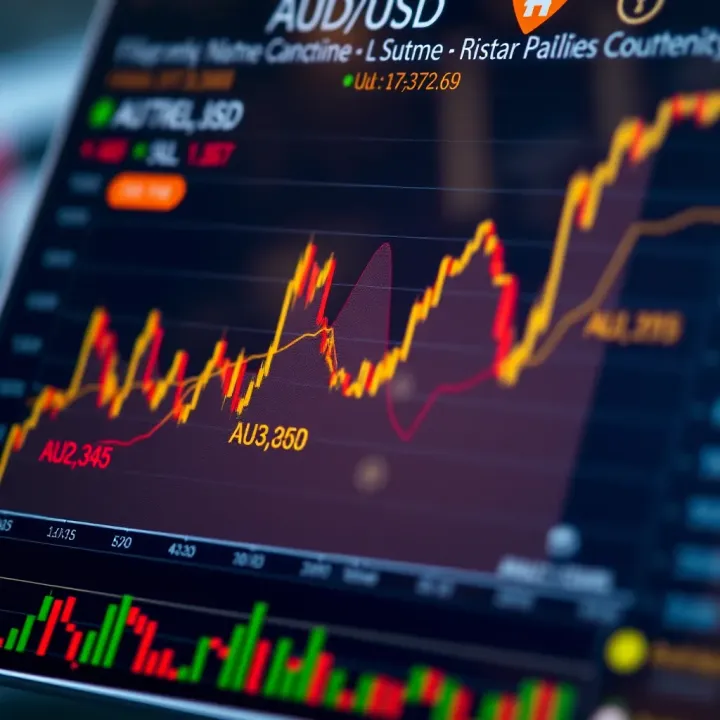
Australia is a major commodities exporter, dealing in iron ore, coal, gold, and more. Changes in commodity prices have a direct effect on the Australian dollar. When prices of key exports rise, the local economy benefits and the AUD often strengthens. Conversely, a drop in commodity prices can drag the currency down. As an example, a surge in iron ore prices can make the AUD climb in value because it improves Australia’s trade balance, attracting foreign investment.
The US Federal Reserve’s stance on interest rates similarly shapes the USD’s strength against the AUD. When the Fed raises rates to combat inflation or normalise the economy, it can strengthen the USD by offering higher returns to investors. This generally causes the AUD/USD pair to decline. On the flip side, dovish Fed signals or rate cuts usually weaken the USD, potentially pushing the AUD/USD pair higher. Traders monitor Fed meetings and speeches closely to gauge future direction.
Inflation rates and unemployment data in the US give clues about economic conditions influencing the USD’s strength. High inflation might prompt the Fed to tighten monetary policy, boosting the USD, while rising unemployment may have an opposite effect. For instance, if US inflation ticks up unexpectedly, it can cause the AUD/USD pair to drop as the USD gains ground. Conversely, weak inflation or jobless claims may encourage a more relaxed Fed approach, benefiting the AUD.
The USD acts as the world’s reserve currency, so factors beyond the US economy also impact its strength. Safe-haven demand during global uncertainty, geopolitical tensions, and overall risk appetite influence the USD. When global investors seek security, the USD tends to strengthen, usually causing the AUD/USD rate to fall. Understanding these broader dynamics is vital since they can override domestic economic signals.
Disputes between major economies like the US and China often ripple through currency markets. Tariffs and trade restrictions can disrupt export flows, impacting Australia's commodities market and thus the AUD. Heightened tensions usually weaken the AUD as traders factor in reduced demand. For example, during the US-China trade war, uncertainty caused volatility in the AUD/USD pair.
The pandemic’s impact on global economies also influenced the AUD/USD. Australia's initial success in controlling COVID-19 helped its currency rebound quickly. Recovery pace differences between Australia and the US can cause shifts in the exchange rate. Ongoing concerns about variants or lockdowns create volatility, so monitoring health developments alongside economic data is essential.
Political stability and policy changes in Australia, the US, or globally can sway the AUD/USD pair. Elections, fiscal stimulus measures, or international agreements often change market sentiment. For instance, unexpected election results or policy announcements can cause sharp currency moves as investors reassess risks and opportunities.
Keeping track of these economic factors allows traders to anticipate shifts in the AUD/USD pair more accurately and adjust their strategies accordingly. A clear understanding of domestic and international data, combined with awareness of global events, offers a solid foundation for navigating this highly traded currency pair.
Technical analysis plays an important role in understanding AUD/USD movements by focusing on past price behaviour and market sentiment. It offers traders and investors tools to identify entry and exit points with greater confidence. This method complements economic and geopolitical analysis by providing immediate signals based on market dynamics rather than fundamental data.
Recent price benchmarks act as reference points where the AUD/USD has frequently reversed or paused. For example, levels like 0.6700 or 0.6900 often serve as short-term hurdles or floors. Traders watch these benchmarks closely to gauge momentum shifts. A break above or below these points can indicate stronger directional moves.
Psychological price points are round numbers that tend to attract attention due to their simplicity and visibility, such as 0.7000 or 0.6500. These levels often reflect trader behaviour more than technical rules. Because many set stop-loss or take-profit orders around these numbers, the pair may hesitate or bounce when approaching them, making them practical zones for trade decisions.
Trading volume patterns reveal the strength behind price movements. High volume near resistance might suggest genuine buying interest pushing the AUD/USD higher, while low volume during a rally could signal weakness. Monitoring volume helps traders confirm if a breakout or breakdown is likely to hold, avoiding traps formed by false moves.
Moving averages and trend lines smooth out price data to identify the direction of the trend. For instance, the 50-day and 200-day moving averages highlight mid- and long-term trends. If the AUD/USD crosses above these averages, it can signal a bullish phase; crossing below might warn of a bearish pullback. Trend lines connect recent highs or lows, offering visual guides for momentum and potential reversal points.
Relative Strength Index (RSI) measures the speed and change of price movements, signalling overbought or oversold conditions. An RSI above 70 typically warns that AUD/USD might be overextended and due for a dip, while readings under 30 suggest the pair could rebound. This indicator aids timing, especially during choppy markets.
MACD and oscillator signals track momentum shifts and trend strength. The Moving Average Convergence Divergence (MACD) shows the relationship between two moving averages, producing signals when the lines cross. Oscillators like the Stochastic indicator can pinpoint short-term reversals by comparing closing prices with their price range over time. These tools help anticipate turning points beyond just price levels.
Bullish and bearish outlooks arise when technical indicators align. A bullish outlook might see the AUD/USD maintaining above key moving averages with rising RSI and volume, suggesting sustained buying interest. Conversely, a bearish scenario could play out if the pair struggles below resistance levels with declining momentum signs, hinting at possible further falls.
Breakout and reversal possibilities depend on how the pair interacts with support and resistance zones. A breakout beyond a strong level like 0.7000, confirmed by volume, may lead to price surges. Alternatively, failure to breach that point or a sharp reversal at oversold RSI might signal a retracement or consolidation phase.
Impact of key economic announcements often amplifies technical signals. For example, if an RBA interest rate decision surprises markets positively, the AUD/USD may break above resistance with strong volume and bullish indicators lining up. Traders must watch economic calendars closely to anticipate such moves and adjust positions accordingly.
Technical analysis isn’t a crystal ball, but when combined with fundamental knowledge, it sharpens your edge in the fast-moving AUD/USD market.
Understanding these technical aspects equips you to make informed trading decisions, manage risk, and capitalise on market movements effectively.
Expert predictions and market sentiment are vital tools for traders and investors following the AUD/USD currency pair. These insights provide a clearer understanding of how the market is likely to move, helping you time your trades better and manage risk effectively. They reflect a blend of fundamental analysis, technical outlooks, and the collective mood of market participants, allowing for more informed decision-making.
Short-term expectations often focus on immediate factors like upcoming economic data releases, interest rate decisions, or geopolitical events. For example, if the Reserve Bank of Australia (RBA) signals a possible rate hike or the US Federal Reserve hints at a pause, analysts quickly update their forecasts. These short-term outlooks help traders adjust positions around volatile periods like RBA meetings or US jobs reports, where prices can swing sharply within hours or days.
Medium to long-term views consider broader economic trends such as sustained GDP growth, long-term commodity prices, and structural policy changes. Analysts might forecast whether the Australian dollar will strengthen over the next 6 to 12 months based on iron ore demand or US trade policies. These longer-term perspectives guide investors planning to hold positions over weeks or months, helping them spot enduring trends beyond daily or weekly noise.
The Commitment of Traders (COT) reports reveal how major market players like banks, hedge funds, and speculators are positioned in the AUD/USD futures market. When large institutions increase long positions on the Aussie dollar, it often signals confidence in its rise. Conversely, a sharp build-up of short positions might hint at a forthcoming downturn. Following these reports can give a valuable heads-up on potential market shifts before price movements become obvious.
Retail and institutional positioning reflects the overall balance between individual traders and big financial firms. South African brokers often report that retail traders tend to crowd into common trade setups—like buying dips or selling rallies—which sometimes contrasts with institutional strategies. Knowing where retail money stands can alert you to crowded trades, where the market may reverse unexpectedly once positions unwind.
Impact of risk appetite changes is particularly relevant for AUD/USD as the Australian dollar is often seen as a proxy for global risk sentiment. When investors are confident, they tend to favour riskier assets like the AUD, driven by higher commodity prices and growth prospects. However, during risk-off periods—triggered by events like escalating trade disputes or global economic slowdown—the Aussie often weakens as traders flock to the safety of the US dollar. Keeping an eye on measures like the VIX or global stock indices can help anticipate these swings.
Understanding market sentiment and expert forecasts allows you to navigate the AUD/USD pair with greater insight, balancing short-term moves against longer-term trends, and recognising when shifts in trader behaviour signal bigger changes ahead.
Trading the AUD/USD currency pair requires more than just following market trends — practical strategies are critical to manage risks and optimise returns. This section offers actionable advice tailored to traders investing in this pair, especially relevant in navigating the unique dynamics between the Australian and US economies.
Setting stop losses and take profits helps you protect your capital and lock in gains. A stop loss automatically exits a trade if the price moves against you by a set amount, while take profit closes a position once your target price is reached. For instance, if you buy AUD/USD at 0.7000 expecting an upward move, placing a stop loss at 0.6950 caps losses to 50 pips. Similarly, setting a take profit at 0.7100 secures gains if the price rises as anticipated. This approach prevents emotional decision-making when markets swing, which they often do during economic announcements.
Managing exposure and leverage is vital given the often volatile swings in AUD/USD. Leverage allows you to control a larger position with smaller capital, but it amplifies both profits and losses. South African traders should be cautious not to over-leverage, especially during times of heightened uncertainty like RBA rate decisions or US Federal Reserve announcements. A practical rule is to risk no more than 1-2% of your trading capital on any single position. Also, diversify your trades rather than putting too much on one move. By controlling exposure, you survive losing streaks without major damage to your portfolio.
Popular brokers in South Africa such as IG, Plus500, and FXTM offer AUD/USD trading with competitive spreads and robust platforms. It's important to pick brokers regulated by entities like the FSCA for added security and transparency. These brokers often provide local payment options, including EFT and credit cards, easing the deposit and withdrawal process for South African traders. Making sure your broker offers reliable execution speeds and decent customer service is crucial when trading fast-moving pairs like AUD/USD.
Useful charting and data resources help you track price action and economic data related to the AUD/USD. Platforms like TradingView and MetaTrader provide real-time charts featuring key indicators such as moving averages, RSI, and MACD. Also, accessing economic releases through websites like Investing.com or a dedicated economic calendar app keeps you ahead of events that influence this pair. Using quality data and intuitive charts improves your ability to spot trade setups and manage risk effectively.
Economic calendars and news feeds are your daily companions when trading AUD/USD. They list upcoming reports like Australian employment figures, US CPI data, or global events that could sway the currency pair. For example, knowing the exact time of a Reserve Bank of Australia (RBA) rate statement helps you avoid unexpected volatility or capitalise on it. Resources like Bloomberg, Reuters, or local financial news platforms keep you informed.
Following central bank announcements closely is essential. The RBA and US Federal Reserve decisions often trigger sharp moves in AUD/USD. Traders who track meeting dates and closely read accompanying statements or press conferences fare better by anticipating market reactions. For instance, a dovish Fed stance might weaken the USD, lifting AUD/USD prices. Keeping an ear to these updates allows you to adjust your strategy or trade size ahead of time rather than being caught off guard.
When dealing with AUD/USD, combining solid risk control, the right tools, and staying up to date with economic data creates a stronger foundation for successful trading.
📈 Discover what’s driving platinum prices 🔍 and get a clear outlook on trends, market forces, and economic impacts shaping the South African market.

📉 Explore key trends and expert forecasts on Rand to Dollar exchange rates. Learn how global events impact your finances and smart risk management tips. 💡

📊 Explore the key factors shaping the NZD/USD rate, including economic trends, Fed & RBNZ moves, and smart strategies for accurate forex forecasting.
📈 Explore NZD to ZAR trends, economic factors, and key events shaping the exchange rate. Get expert insights and risk tips for South African traders.
Based on 10 reviews